


The Effects of COVID-19 on Climate Change
- ywacc.ngo

- Mar 31, 2020
- 2 min read
With the sweeping devastation of COVID-19 on our lives- there may be one positive to stem from this dangerous pandemic. For the first time since the rise of the Industrial era, there has been a significant decrease in air pollution and greenhouse gasses.
In China, emissions fell nearly 25% in the early months of January and February as citizens were instructed to self-isolate and/or quarantine at home (BBC). Skies were rid of smog and smoke, revealing clear air. This contrast in air quality is even more striking once it is discovered that the beginning of the year usually houses the “worst” air quality. The months of January, and especially February have the highest concentration of PM2.5- particles released from burning fuels that have a diameter less than 2.5 micrometers (WSJ). This may be the result of economic growth, an increase in industry, and increased transportation surrounding Lunar New Year, which usually takes place late January or early-mid February. Experts believe that this short 25% decrease will lead to an overall fall of about 1% in China’s emissions this year (BBC).
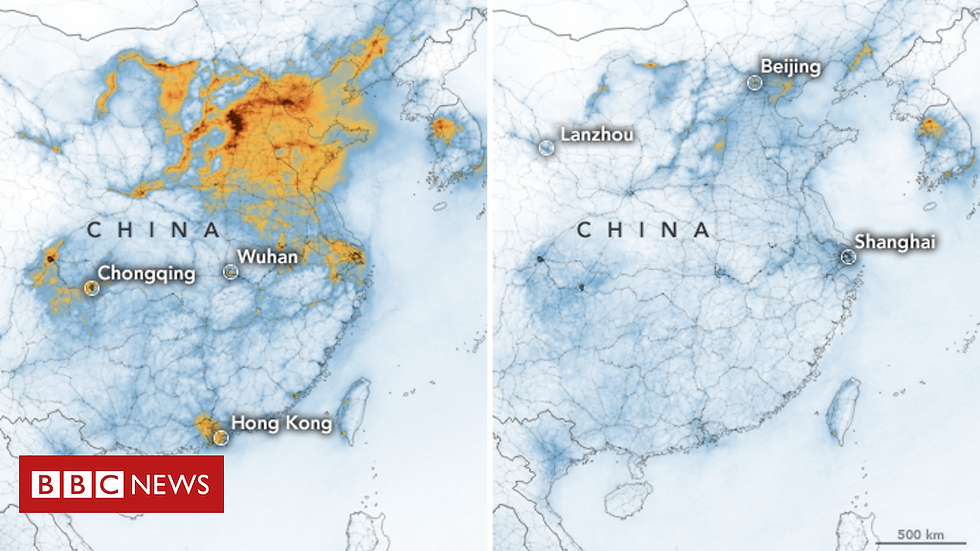
In Italy, as well as China, there has been a significant fall in the level of nitrogen dioxide. Nitrogen dioxide is a greenhouse gas that damages vegetation and contributes to the creation of acid rain. It is produced when nitrogen monoxide generated by locomotive transportation and industrial activity combines with ozone gas. Prof Corinne Le Quéré from the University of East Anglia suspects that if the COVID- 19 pandemic remains ongoing for three to four more months, “...we will see something in the global emissions this year” (BBC).

In New York the statistics are just as blatant. Just over the course of a couple of days, emissions of carbon monoxide have fallen by around 50% (BBC). Researchers from Columbia University have also found that there was a 5-10% drop in CO2 in New York and a “solid drop” in methane as well (BBC).
All this leaves us to wonder, if this drastic change was made possible over the course of just three short months, What can be done in a year? A decade? A lifetime? It also leaves us to wonder, what will happen after the threat of COVID-19 subsides? Will people adapt to a more green way of life, or will there be a shot of greenhouse gas emissions from the transportation, industry, and other sectors? Unfortunately, the second option seems more likely as mirrored the 2008 global financial crash. The following year had a 5% increase in carbon emissions as a result of spending that boosted fossil fuel usage (Nature).
Global change is needed, and it needs to start now. If there is one ultimate take away from this pandemic, it is that we are the true virus slowly killing our planet.
Sources and Other Helpful Links:


Comments